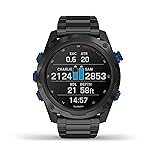
Shearwater Teric
The benchmark for dedicated divers
⚠ Affiliate link — we earn a commission at no cost to you. Always verify equipment compatibility with your dive setup before purchase.
The Shearwater Teric and the Garmin Descent represent two fundamentally different approaches to the air integrated dive computer. The Teric is a dedicated dive instrument built for underwater clarity and technical capability. The Garmin Descent is a multisport smartwatch with a powerful dive mode. Both use the Bühlmann ZHL-16C algorithm with gradient factors — the right choice depends on whether diving or surface versatility is your priority.
Are you a diver who needs a watch, or an athlete who needs a dive function? Both computers sit at the premium tier of air integrated dive computers — both include wireless air integration and a digital compass — but they answer that question in fundamentally different ways. This guide examines every meaningful difference so you can decide which philosophy fits your diving.
The Shearwater Teric descends from a lineage of dedicated dive computers built for technical divers. The Garmin Descent descends from the Fenix and Epix multisport smartwatch platform. This difference in design DNA shapes every decision — from how menus are structured to what information appears on screen during a dive.
The Teric uses a four-button interface designed for gloved operation in cold water. The full-colour AMOLED display prioritises depth, time, NDL, and tank pressure with colour-coded status indicators. Menu navigation is consistent and predictable — critical when task-loaded at depth.
The Shearwater Teric's four physical buttons are arranged at the two and eight o'clock positions on the watch case, enabling single-handed operation even in a thick neoprene glove. Each button retains the same function throughout the entire menu tree — there is no context switching where the same button does different things on different screens. Shearwater designed this deliberately: when you are managing a decompression obligation in low visibility, muscle memory needs to work without conscious thought.
The AMOLED display runs Shearwater's colour-coded status system, refined across multiple product generations. Safe conditions appear in green; approaching limits in yellow; warnings in red. This logic applies uniformly to air time remaining, NDL, ascent rate, and decompression status. Any diver trained on a Shearwater Perdix or Peregrine will find the same visual language on the Teric with no relearning required.
Customisable screen layouts allow you to choose which data fields appear, but Shearwater's design principle is that critical information is always present without navigation. Depth, elapsed dive time, current heading, and remaining tank pressure are visible simultaneously on the primary screen. The secondary compass screen is a single button press away.
For firmware notes and full technical specifications, see the Shearwater official Teric page.
The Garmin Descent uses a five-button system with optional touchscreen on the Mk3i. Dive mode is one activity within a broader fitness platform, meaning dive settings share menu space with running, cycling, and smartwatch functions. The learning curve is steeper, but the breadth of capability is unmatched.
The Garmin Descent runs on Connect IQ — the same operating system powering the Fenix and Epix multisport smartwatch lines. Dive mode is a fully featured activity app within this ecosystem, sitting alongside running, cycling, swimming, strength training, golf, and dozens of other sport profiles. This architecture is why the Descent can replace multiple single-purpose devices, but also why diving-specific settings are not always where a dive-first user would expect to find them.
Five buttons control all navigation on the Mk2i. The Mk3i adds a touchscreen active for surface use and menu navigation, which automatically disables underwater to prevent accidental activation during a dive. Both models allow full dive configuration from the wrist — gas mixes, gradient factors, and mode selection do not require a smartphone.
The menu depth reflects the platform's breadth. Configuring a trimix dive profile requires navigating through a settings architecture shared with fitness, health, and smartwatch preferences. For someone using the Descent exclusively for diving, this structure feels unfamiliar initially. For someone using it daily as a fitness and lifestyle watch, the same menus are logical because every sport is an equal citizen of the same platform.
The display across both Mk2i and Mk3i models is capable and legible underwater. The Mk3i's AMOLED panel is excellent; the Mk2i's MIP transflective display performs well in sunlight and bright conditions but is less vibrant in low light or at depth without manual backlighting. Full product details are on the Garmin official Descent Mk3i page.
Both the Shearwater Teric and the Garmin Descent Mk2i and Mk3i are premium air integrated dive computers with digital compass, Bühlmann ZHL-16C algorithm, gradient factor control, and multi-gas technical diving support. The differences lie in display technology, transmitter ecosystem, battery priorities, and surface functionality.
| Spec | Shearwater Teric | Garmin Descent Mk2i | Garmin Descent Mk3i (51mm) |
|---|---|---|---|
| Display | 1.39" AMOLED (400×400) | 1.4" MIP (transflective) | 1.4" AMOLED |
| Screen cover | Sapphire crystal | Sapphire crystal | Sapphire crystal |
| Compass | 3-axis tilt-compensated | 3-axis | 3-axis |
| Algorithm | Bühlmann ZHL-16C + GF | Bühlmann ZHL-16C + GF | Bühlmann ZHL-16C + GF |
| Dive modes | OC Rec, OC Tec, CCR/BO, Freedive, Gauge | Single gas, multi-gas, gauge, apnea, apnea hunt, CCR | Single gas, multi-gas, gauge, apnea, apnea hunt, CCR |
| Gas mixes | Up to 5 OC + 5 CC | Nitrox, trimix, 100% O₂ | Nitrox, trimix, 100% O₂ |
| AI transmitter | SWIFT (up to 2 tanks) | T1 SubWave (up to 5 tanks) | T2 SubWave (up to 8 tanks) |
| Transmitter range | ~1m (RF) | ~10m (sonar) | ~10m (sonar) |
| Diver-to-diver messaging | No | No | Yes (T2 required, 30m range) |
| Battery — dive mode | ~30 hours | ~80 hrs (32 hrs with T1 paired) | ~66 hours |
| Battery — smartwatch | ~50 hours | ~16 days | ~25 days |
| Depth rating | 200m / 660ft | 100m / 330ft | 200m / 660ft |
| GPS | No | Yes | Yes |
| Fitness tracking | No | Full Garmin suite | Full Garmin suite |
| Contactless payments | No | Garmin Pay | Garmin Pay |
| Music storage | No | Yes | Yes |
| Charging | Wireless Qi-compatible | Proprietary USB | Proprietary USB |
| Build | 316 stainless steel bezel | Titanium bezel | Titanium bezel (DLC coated) |
| Approx. price (computer only) | $1,200–$1,400 | $1,100–$1,300 | $1,300–$1,500 |
Specifications sourced from Shearwater Research and Garmin official product pages. Prices are approximate US retail as of June 2026 — always verify current pricing before purchase.
Both computers run the Bühlmann ZHL-16C decompression algorithm with user-adjustable gradient factors. The algorithm itself is functionally identical. The meaningful difference is how each computer displays the algorithm's output — colour coding, data prioritisation, and at-a-glance readability during task-loaded dives.
The Bühlmann ZHL-16C is the dive industry's most widely deployed decompression model. It calculates inert gas loading across 16 tissue compartments and determines safe ascent rates and required decompression stops. When two computers use the same algorithm with identical gradient factor settings, they will produce mathematically equivalent decompression schedules for the same dive profile — there is no algorithmic advantage to either computer.
The divergence lies entirely in how each computer communicates the algorithm's output. The Teric presents critical data through a colour-coded status system: green for safe, yellow for caution, red for warning. Primary figures — depth, time, NDL, tank pressure — occupy fixed screen positions in a layout tuned for rapid pattern recognition under stress. The Garmin's display is capable and accurate, but it presents data within a visual framework designed to serve dozens of different sports, so information hierarchy is optimised for generality rather than dive-specific readability.
Gradient factors allow both computers to be dialled more conservatively or aggressively than the algorithm's default output. Recreational divers can use either computer with factory defaults throughout their diving careers. Technical divers who actively manage GF settings will find both computers capable of precise configuration. For independent guidance on decompression safety and ascent rate management, Divers Alert Network (DAN) publishes peer-reviewed research on dive computer algorithms.
The Shearwater Teric uses the SWIFT transmitter on 38kHz radio frequency with a range of approximately one metre, supporting up to two tanks. The Garmin Descent uses the T1 or T2 transmitter on SubWave sonar technology with a range of up to ten metres, supporting up to five tanks (Mk2i) or eight (Mk3i). The two transmitter ecosystems are completely incompatible with each other.
The SWIFT transmitter operates on 38kHz low-frequency radio — the PPS MH8A standard shared with Aqualung and Oceanic computers, meaning a SWIFT transmitter purchased for the Teric is cross-compatible with those brands as well. Low-frequency RF propagates through water over short distances reliably, but physics limits practical range to approximately one metre. The transmitter on your regulator first stage and the Teric on your wrist maintain a stable connection during normal diving, with the transmitter positioned for a reasonably clear line of sight. The Teric supports up to two simultaneous transmitters — sufficient for a sidemount or doubles configuration.
Garmin's SubWave technology uses acoustic sonar rather than radio waves, propagating pressure waves through the water column rather than electromagnetic signals. Sonar travels through water with far less attenuation than radio, which is why SubWave achieves a ten-metre range compared to SWIFT's one metre. In practical terms this means a transmitter mounted on a sidemount cylinder behind your hip — or on a stage tank — still communicates reliably with the Descent on your wrist regardless of body position. The T1 transmitter supports up to five tanks with the Mk2i; the T2 transceiver supports up to eight with the Mk3i.
The T2 transceiver paired with the Mk3i adds a capability without parallel in consumer dive computers: diver-to-diver messaging. Pre-formatted messages — ascend, descend, OK, low air, problem — can be transmitted between two Mk3i computers with T2 transceivers at ranges up to 30 metres. This does not replace underwater communication slates, light signals, or hand signals, but provides a supplementary data channel useful for technical diving teams and instructors monitoring student computers simultaneously.
The two ecosystems are entirely incompatible. Shearwater SWIFT transmitters will not communicate with a Garmin Descent, and Garmin T1 or T2 transmitters will not communicate with a Shearwater Teric. Switching brands means purchasing a new transmitter. For a full breakdown of transmitter compatibility across all major brands, see our transmitter compatibility guide (coming soon).
The Garmin Descent is a full Garmin smartwatch with GPS, heart rate monitoring, sleep tracking, Garmin Pay, music storage, and integration with the Garmin Connect ecosystem. The Shearwater Teric tells the time and receives basic Bluetooth notifications. If surface functionality matters to you, this is the widest gap between the two computers.
Between dives, the Garmin Descent functions as a full-featured Garmin smartwatch. GPS records surface swim tracks, boat rides to dive sites, and shore excursions. Heart rate, SpO2, sleep quality, stress levels, and body battery estimates are monitored continuously. Garmin Pay enables contactless payments. Up to 500 songs can be stored locally for offline listening without a phone. Smart notifications from iOS and Android display on the wrist. All dive data syncs automatically to the Garmin Dive app, where depth profiles, gas consumption data, and logbook entries are stored and shareable. The full Garmin Connect fitness platform aggregates running, swimming, cycling, and dive data in one place.
The Shearwater Teric, between dives, tells the time and date. Basic Bluetooth notifications from a paired phone are displayed on screen. Dive logs sync to Shearwater Cloud via the Shearwater mobile app, providing a complete logbook with depth profiles, gas data, and tissue loading history. There is no GPS, no heart rate sensor, no fitness tracking, and no payment capability. For divers who wear a separate fitness watch daily and treat their dive computer purely as safety equipment, these omissions are not limitations — they are the result of a focused design philosophy.
The right answer depends entirely on how you plan to use the device across the full day. This is the single widest gap between the two computers, and it is worth being honest with yourself about whether you will wear the Teric as a daily watch or keep it in your dive bag between trips.
The Teric prioritises battery life in dive mode — approximately 30 hours on a full charge. The Garmin Descent prioritises daily-wear longevity — up to 25 days in smartwatch mode on the Mk3i. For a week-long dive trip, the Teric needs charging between dive days. The Garmin can last the entire trip as a smartwatch and still have dive hours in reserve.
The Teric's 30-hour dive mode endurance translates to approximately four to five full dive days before a charge is required, assuming two to three hours of underwater time per day. Charging is via any standard Qi-compatible wireless pad — the same charger used by most modern smartphones. A full charge takes roughly one hour, and most liveaboard operators provide cabin power, making overnight charging routine. In daily-wear mode the Teric runs for approximately 50 hours, meaning it can function as a watch throughout surface intervals without significant drain on dive reserves.
The Garmin Descent Mk2i's headline 80-hour dive mode figure requires an important qualifier: with the T1 SubWave transmitter actively paired, battery life drops to approximately 32 hours — closer to the Teric's figure than the spec sheet suggests. The Mk3i offers approximately 66 hours in dive mode regardless of transmitter pairing, and 25 days in smartwatch mode. Both Garmin models charge via a proprietary USB cable unique to the Descent line. If the cable is misplaced mid-trip, a standard USB cable will not substitute — it is worth packing a spare, particularly for liveaboard travel where replacement accessories may be unavailable.
The right choice depends on how you use your dive computer outside the water. Divers who prioritise underwater clarity and technical capability will gravitate toward the Teric. Divers who want one device for diving, fitness, and daily wear will prefer the Garmin Descent.
If diving is your primary activity and you want the clearest, most intuitive display underwater with the simplest operation under stress, the Teric is the natural choice. Its four-button interface, AMOLED clarity, and technical diving pedigree — including dedicated sidemount mode and CCR support — make it the benchmark for serious divers.
This diver measures a good computer by how it performs at 30 metres in a surge channel, not at the coffee shop. They may be an instructor running four dives a week, a technical diver managing gas switches across multiple stages, or an enthusiast who logs fifty or more dives per year and views their computer as primary safety equipment. The Teric's four-button interface is operable in 7mm gloves. Its AMOLED display is legible under a kelp canopy, in a cave with a torch, or on a night dive without adjusting any settings. These are the conditions the Teric was engineered for.
If you run, cycle, hike, and dive — and want one device that tracks everything — the Garmin Descent replaces multiple gadgets. Its dive capability is excellent, and its surface utility is unmatched. The trade-off is a more complex menu system and a display that serves many masters rather than one.
This diver wears the Descent 365 days a year. On weekdays it logs their running splits and resting heart rate; on weekends it records their dive profiles and marks their entry point via GPS. They value having Garmin Connect aggregate all their training and recreational data in one timeline. The dive capabilities of the Mk2i or Mk3i substantially exceed what most recreational and advanced divers will ever use — trimix mode, CCR support, and multi-tank monitoring remain unused for the majority of owners, but having the capability available without a separate computer is the point.
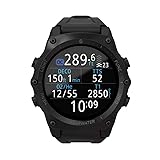
Divers who prefer a larger screen over a watch form factor should consider the Shearwater Perdix 2 or Perdix AI. These share the Teric's Bühlmann algorithm, SWIFT transmitter compatibility, and dive-first interface but use a larger rectangular colour display that is easier to read with thick gloves. The Perdix typically costs less than the Teric.
If everything about the Teric's dive philosophy appeals but the watch form factor does not suit your diving style, the Perdix is the natural alternative — same Shearwater ecosystem, same Bühlmann algorithm with gradient factors, same SWIFT transmitter compatibility, larger rectangular display, lower price point. It is not covered in detail on this page, but see the full product comparison on the homepage for a side-by-side overview of all five computers covered on this site.
No. The Shearwater SWIFT uses 38kHz radio frequency and the Garmin Descent uses SubWave sonar. These are completely different technologies that cannot communicate with each other. If you switch from one brand to the other, you will need to buy a new transmitter.
No. The Shearwater Teric does not have GPS, fitness tracking, or smartwatch features beyond basic timekeeping and Bluetooth notifications. It is a dedicated dive computer designed exclusively for underwater performance. If you need GPS to mark dive entry and exit points, the Garmin Descent includes this feature.
It depends on your usage pattern. The Teric offers approximately 30 hours of dive time and charges wirelessly in about an hour — sufficient for a liveaboard trip with daily charging. The Garmin Descent Mk3i offers up to 25 days of smartwatch use with approximately 66 hours of dive time, meaning it may last an entire trip without charging if dive hours are moderate.
Yes — the Garmin Descent supports multi-gas trimix diving, CCR mode, and user-adjustable gradient factors. However, most dedicated technical divers prefer the Shearwater Teric or Perdix for their more intuitive dive-focused interface and established reputation in the technical diving community. The Garmin's dive capabilities exceed what most recreational and advanced divers will ever need.
The Shearwater Teric's 1.39-inch AMOLED display is widely regarded as the clearest dive computer screen on the market, with contrast and colour science specifically tuned for underwater viewing. The Garmin Descent Mk3i also uses an AMOLED display and is excellent, though its layout serves multiple activities rather than being dive-optimised. The older Mk2i uses a MIP transflective display — good in sunlight but less vibrant at depth in low light.
The Garmin Descent Mk2i and Mk3i can monitor the tank pressure of other divers using SubWave transmitters within a 10-metre range. The Mk3i with T2 transceivers also supports pre-formatted diver-to-diver messaging at up to 30 metres. The Shearwater Teric does not have any buddy monitoring or underwater messaging capability.
Both computers are available on Amazon. Prices fluctuate — check current listings and confirm compatibility with your existing transmitter before purchasing.
The benchmark for dedicated divers
⚠ Affiliate link — we earn a commission at no cost to you. Always verify equipment compatibility with your dive setup before purchase.
The multisport diver's all-in-one
⚠ Affiliate link — we earn a commission at no cost to you. Always verify equipment compatibility with your dive setup before purchase.